
A 31-year-old dental hygienist presented to the office with persistent mid-back pain and stiffness, accompanied by lower back and hip discomfort. Her work required prolonged leaning over patients, leading to postural strain and spinal subluxation. A detailed evaluation, including motion X-ray analysis and thermographic scanning, revealed significant restrictions in her cervical, thoracic and lumbar spine, affecting her nervous system function. Her care plan was set at twice a week for a month and eventually transitioned to every other week by the half year mark. Care focused on restoring spinal motion, improving posture, and reducing nervous system interference through specific adjustments and postural retraining exercises.
After four months of consistent chiropractic care, she reported significant improvements in her daily work experience. Her mid-back stiffness had diminished, and she experienced minimal discomfort throughout the day. Additionally, her lower back and hip pain had subsided, allowing her to engage in more vigorous workouts without post-exercise setbacks. She also noted increased energy levels, which contributed to better focus and efficiency at work. Follow-up motion X-rays showed improved spinal alignment and segmental motion, indicating enhanced biomechanical function and reduced stress on her nervous system.
By the end of a year of care, she had transitioned to a maintenance schedule, receiving adjustments every few months to sustain her progress. With regular preventative care, she is maintaining optimal nervous system function, preventing the return of postural strain-related discomfort. She reported feeling stronger, more resilient, and better equipped to handle the physical demands of her profession. Her case highlights the effectiveness of the Pierce Results System in not only addressing symptomatic relief but also optimizing long-term spinal health and overall well-being
Tracking Progress through Infrared Thermography
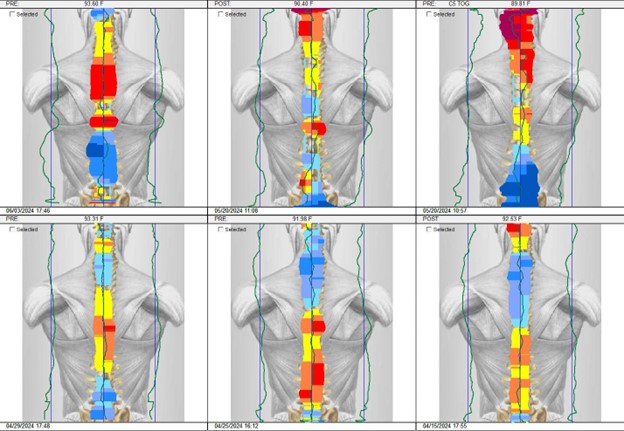
When looking at her scans, we see three great scans on the bottom. With the top right scan we start to get the darker reds, which is showing us nerve dysfunction, indicating the need for an adjustment. Her scans were looking really good except for the flare up in the top right scan, which was cleared out, and the next visit (top left scan) her scan stayed clear.
Find out if Specific Chiropractic Care Is Right For Your Family
Schedule A New Patient Evaluation Today
We are Happy to Help You Get Healthy and Stay Healthy!
